
Everyday emergency preparedness
Ready enough.
Emergency basics for people who don't want a bunker. Just a plan.
Power outages. Storms. Smoke. Flooding. Earthquakes. Winter weather. Transit disruptions. A week where your phone, fridge, elevator, or neighbourhood decides to become a problem.
You don't need to prepare for every possible disaster. You need a few useful things before you need them.
Ready enough beats perfectly unprepared.
Leave Early provides general emergency-preparedness education. It isn't a substitute for local emergency instructions, medical care, emergency services, insurance advice, legal advice, or specialized support.
If there's an immediate emergency, follow instructions from local authorities and emergency personnel.
Emergency needs vary by region, household, health needs, access needs, and situation. Use official local guidance and choose what fits your life.
Prepared doesn't mean paranoid.
Emergency preparation has an image problem.
It can sound like you need a bunker, a warehouse, a generator, twelve cases of beans, and a neighbour named Gary who has been predicting the end of civilization since 2004.
You don't.
You need a few useful supplies, a way to contact people, a basic plan, and enough information to make the first few days less chaotic.
You don't need a bunker. You need a few useful things before you need them.
The six things framework
Start with the essentials.
Water
Enough drinking and basic-use water for the people and animals in your home.
Food
Food you can eat, prepare, and rotate without turning your pantry into a science experiment.
Health
Medication, medical supplies, mobility or communication supports, infant needs, and the things your body actually relies on.
Light and power
Flashlights, batteries, charging options, and a way to get information if the usual systems are down.
People and information
Contacts, meeting plans, local alerts, emergency numbers, and a way to check in.
Warmth, shelter, and practical stuff
Clothing, blankets, hygiene supplies, keys, cash, documents, pet needs, and whatever fits your household.
Start with the thing you'd miss first.
Pick your starting point
Start with the version of life you actually have.
I live alone
A simple plan for one person, one home, and one set of needs.
Build a solo planI live with roommates
Shared supplies, shared plans, and the exciting question of who owns the only flashlight.
Plan with roommatesI have children or dependants
Plans, supplies, comfort, medication, communication, and practical needs for people who rely on you.
Build a family planI have pets or a service animal
Food, water, medication, transport, identification, and plans that include them.
Include pets and service animalsI have accessibility, health, or medication needs
Build a realistic plan around mobility, communication, medication, medical equipment, sensory needs, and care support.
Make it fit my needsI live in an apartment, condo, or rental
Small-space storage, elevators, shared buildings, building management, exits, and practical supplies.
Plan for my building
Your household may fit more than one card. That's normal. Pick the one that feels most useful today.
Browse by topic
Pick what matters where you live.
Each topic is a short, practical guide. Start with the one that fits your home, your region, or whatever's on your mind.
Emergency kit
What to include and where to keep it.
ReadHousehold plan
Contacts, meeting points, and check-ins.
ReadPower outages
What to do when the lights go out.
ReadWeather and smoke
Storms, heat, smoke, winter, and flooding.
ReadEarthquakes
Drop, cover, hold on — and what comes after.
ReadApartment and rental
Preparedness without a basement.
ReadCommunity
Knowing a neighbour is a supply.
ReadSeasonal reset
Twice a year, when the clocks change.
Read
Interactive tools
Build, check, and print.
Build a kit you can actually find.
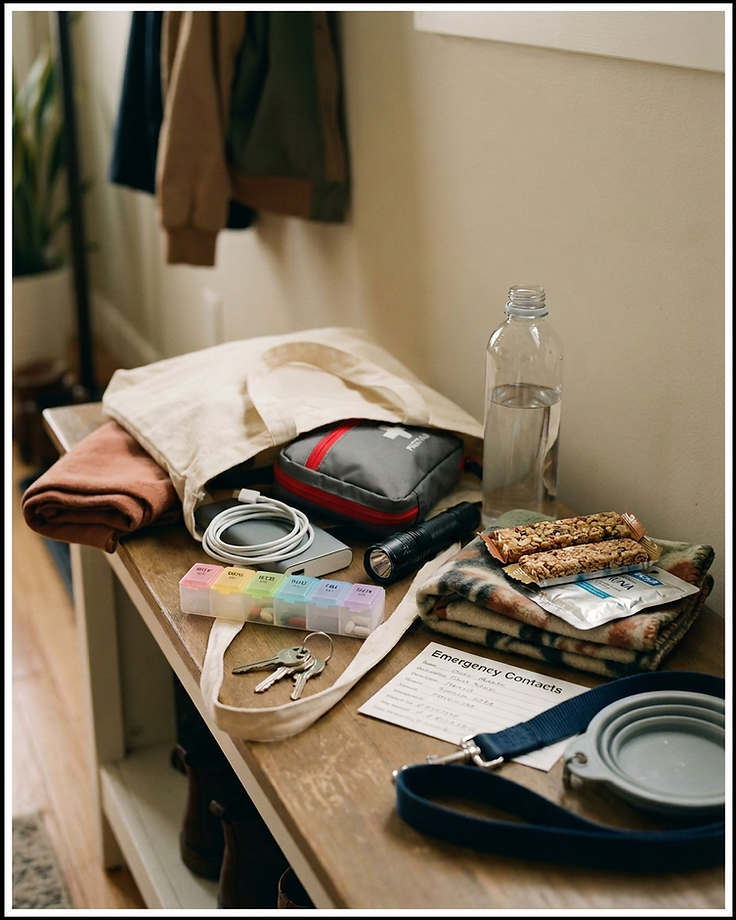
A useful emergency kit doesn't need to be perfect. It needs to be somewhere you can reach it, stocked with things you can use, and updated before the flashlight batteries become tiny museum artifacts.
A flashlight you can find beats an elaborate kit you forgot exists.
Make a plan before everyone's phones die.
Choose who you'll contact, where you'll meet, how you'll check in, and what you'll do if home, work, school, or transport suddenly becomes complicated.
A backup is just an exit you prepared in advance.
Local information beats generic panic.
Emergencies are local. What matters in Vancouver may not be what matters in Winnipeg, Iqaluit, Halifax, Kelowna, or a small town where the only open store closes at 6.
Use official provincial, territorial, municipal, and emergency-management guidance for the risks and alerts that apply where you live.
Official Canadian guidance
Start with verified official information.
These Government of Canada resources have been reviewed. Service details and links can change — confirm current information directly with the source before relying on it.
Government of Canada: Emergency kits
Official Government of Canada resourceOfficial Canadian information about emergency kits and how to prepare to be self-sufficient for at least 72 hours.
View official emergency-kit guidanceGovernment of Canada: Emergency preparedness
Official Government of Canada resourceOfficial Canadian information about planning and preparing for emergencies.
View emergency preparedness informationGovernment of Canada: Your Emergency Preparedness Guide
Official Government of Canada resourceGeneral Canadian guidance for building an emergency plan and preparing a 72-hour kit.
Read the preparedness guideMore from Leave Early
Other useful starting points.
Build your personal safety plan
Everyday awareness, exits, and boundaries.
GoFind the words before you need them
A boundary script deck.
GoHelp a friend leave
Support without taking over.
GoEmergency basics for sudden situations
When something happens right now.
GoSupport when leaving isn't simple
For complicated situations.
GoEmergency and support resources
Verified Canadian pathways.
GoTravel smart, not scared
Travel-specific planning.
GoPractise a better next move
Short, choice-based scenarios.
GoGet one useful safety habit a week
The Boring Wins Letter.
Go